
How Homer Laughlin's Eggshell Body Actually Makes Dinnerware Lighter Without Sacrificing Strength
For decades, commercial buyers and home collectors alike have noticed that certain Homer Laughlin pieces feel noticeably lighter in hand than comparable china from other manufacturers. That difference isn’t accidental—it’s the result of our eggshell body formula, a vitrified china composition we’ve refined since the mid-20th century.
The term “eggshell” doesn’t refer to fragility; it describes the body’s relative thinness and the way light subtly transmits through the rim when held to a window. We developed this formula to meet the demands of high-volume restaurant service, where lighter pieces reduce server fatigue over eight-hour shifts while still surviving commercial dishwashers and the inevitable knocks of daily use.
Why Traditional China Bodies Are Heavier Than Necessary
Most porcelain and bone china formulas prioritize density as a proxy for durability. Manufacturers add extra feldspar and clay to thicken the walls, assuming thicker bodies automatically mean fewer chips and cracks.
That assumption holds true only if the firing process remains incomplete. When a clay body reaches full vitrification—the point where particles fuse into a glasslike matrix—the material gains strength from molecular bonding, not just mass. A fully vitrified thin wall can outperform a thicker, under-fired one.
The challenge lies in firing thin pieces without warping. As the kiln temperature climbs above 2,300°F, thinner plates and bowls tend to slump or distort unless the clay formula includes specific stabilizers. Our eggshell body uses a higher ratio of kaolin to ball clay, which maintains rigidity during the vitrification window.
How We Reduce Weight While Maintaining Impact Resistance
Our eggshell china dinnerware formula replaces some of the traditional feldspar content with nepheline syenite, a flux that lowers the vitrification temperature by roughly 100°F. This lets us fire thinner pieces to full density without the extended soak times that cause warping.
The body also incorporates a small percentage of talc, which forms enstatite crystals during firing. These microscopic crystals interlock within the glassy matrix, creating what materials engineers call a “crystalline-reinforced composite.” The result is a plate that weighs 25-30% less than a standard hotel-weight piece but passes the same ASTM impact tests.
We measure this in our quality lab by dropping a standardized steel ball from a fixed height onto the center of each plate.
Eggshell vs. Standard Body Drop Test
Eggshell pieces consistently survive the same drop height as our heavier-bodied lines—the thinner wall flexes slightly on impact, absorbing energy that would otherwise concentrate at the point of contact and cause a star crack.
The Role of Firing Curves in Achieving Thin, Strong Bodies
Kiln schedules matter as much as the clay formula itself. Our eggshell body requires a slower ramp rate through the 1,800-2,000°F range, where chemically bound water escapes from the clay particles. Rush this phase, and steam pressure creates microscopic voids that weaken the finished piece.
Once the body reaches 2,200°F, we hold the temperature steady for an extended soak—typically 90 minutes longer than our standard-weight lines. This soak allows the nepheline syenite to fully flux the silica and alumina particles into a single glassy phase.
The cooling curve is equally controlled.
Preventing Thermal Shock in Thin-Walled Pieces
If the kiln cools too quickly below 1,000°F, differential contraction between the glaze and body can cause crazing—a network of fine cracks in the glaze surface. We program a gradual descent over 18 hours, which keeps internal stress below the fracture threshold even in pieces as thin as 2mm at the rim.
Where Eggshell Body Works Best and Where It Doesn't
Eggshell body excels in applications where weight matters: room-service trays that servers carry up multiple flights, airline galley carts with strict load limits, and home settings where older adults prefer lighter pieces. The Hudson pattern we produce in eggshell body has become a favorite in senior living facilities for exactly this reason.
The formula isn’t ideal for every use case, though. Oversized platters and serving bowls above 14 inches require the additional rigidity of our standard body to prevent flex under a full load of food. Similarly, pieces that sit directly on open flame—like stovetop-safe skillets—need the thermal mass of a thicker body to distribute heat evenly.
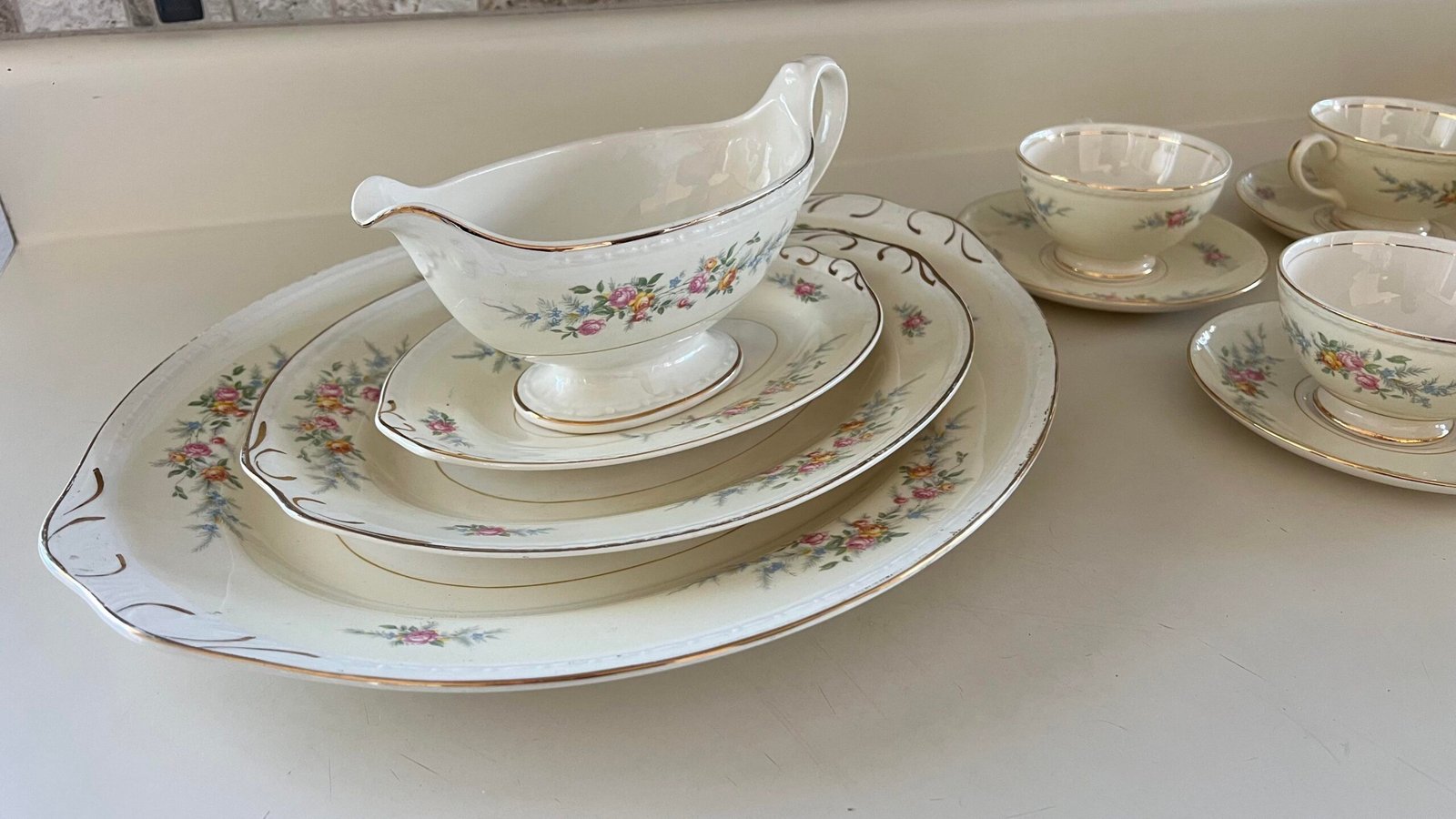
We also manufacture certain historical reproductions, including some Riviera dinnerware pieces, in our original 1930s body formula rather than eggshell. Collectors expect the heft and feel of the vintage originals, and matching that tactile experience matters more than shaving ounces.
Eggshell Body as an Engineering Solution, Not a Marketing Term
The term “eggshell” appears so often in vintage china descriptions that it’s easy to dismiss it as period marketing language. In our case, it describes a specific clay formula and firing protocol we’ve refined across eight decades of manufacturing.
The measurable benefits—reduced server fatigue, lower shipping costs, easier handling for older adults—matter more in daily use than any sales copy could convey. We continue producing both eggshell and standard-weight lines because different applications demand different solutions. When a hospital cafeteria orders 10,000 plates, the weight savings multiply into real operational advantages. When a collector wants a vintage reproduction piece, the authentic heft of the original formula matters more.
What hasn’t changed is the manufacturing standard: every piece, regardless of body thickness, must pass the same impact and thermal shock tests before it earns our backstamp.
Common Questions About Eggshell China Body Construction
No—our eggshell body actually shows lower chip rates in commercial testing. The thinner walls flex slightly on impact, dissipating energy that would otherwise concentrate at edges. Standard-weight pieces are more rigid and transfer impact force directly to the glaze, which increases the likelihood of edge chips.
That said, no china is immune to damage from hard drops onto tile or concrete. The difference appears in everyday handling: butter knives dragged across plates, stacking in crowded cabinets, and the repeated thermal cycling of dishwashers.
Yes to both. The vitrified body contains no metallic additives, so it’s microwave-safe. The glaze formulation is lead-free and cadmium-free, meeting FDA standards for food contact surfaces.
For dishwashers, eggshell pieces handle commercial machines running 180°F rinse cycles with no crazing or glaze degradation. We’ve documented pieces in hotel service exceeding 5,000 wash cycles with no visible wear beyond minor utensil marks on the glaze surface.
Hold the plate up to a bright light source and look at the rim. If you see a faint glow of light transmitting through the thinnest section, it’s likely eggshell body. Standard-weight pieces appear completely opaque even at the rim.
You can also check the backstamp. Most of our eggshell production since 1950 includes the phrase “Eggshell” or “Thin Body” in the mark, though some institutional lines use code numbers instead. If you’re unsure, compare the weight to a piece you know is standard body—the difference is immediately obvious when you hold one in each hand.
The formula and firing process require tighter tolerances than many factories maintain. Nepheline syenite costs roughly 40% more than standard feldspar, and the extended firing cycle increases kiln fuel costs. For manufacturers producing budget dinnerware, the economics don’t justify the investment.
There’s also a perception problem. Many buyers still equate weight with quality, assuming heavier pieces are automatically more durable. We’ve spent decades educating commercial purchasers about the engineering behind eggshell body, but retail customers often pick up two plates, feel the weight difference, and assume the heavier one is better made.
Yes, though the application technique differs slightly. Because the body is thinner, it holds less heat during the glaze-firing stage. We compensate by increasing the peak temperature by 20-30°F to ensure the glaze fully matures and bonds to the body.
Decals and overglaze decorations apply the same way as on standard bodies. The bright glazes associated with our vintage lines work equally well on eggshell and standard bodies—the color comes from metallic oxides in the glaze, not the underlying clay.
Small chips on the rim can be smoothed with fine-grit sandpaper to prevent sharp edges, but true restoration—filling and repainting—is rarely worth the cost unless the piece is a rare pattern. The thin body makes invisible repairs difficult because any filler material shows as a slight thickness change when held to light.
For cracked pieces, repair isn’t practical. The crack will continue to propagate through the vitrified body under thermal stress, even if you glue it. We generally recommend retiring cracked pieces from food service and repurposing them as decorative display items if the pattern has sentimental value.