
Rhythm by Homer Laughlin | Classic Mid-Century Dinnerware
Our Rhythm pattern launched in 1951 as a bold answer to the streamlined aesthetic sweeping American homes. Clean concentric rings encircle each piece in raised relief, creating the signature tactile rhythm that gave the pattern its name. We crafted Rhythm in durable American china—fired at high temperatures for strength that holds up to daily use and dishwasher cycles without chipping or crazing.
Collectors and everyday users alike treasure Rhythm for its versatility: the unadorned surface pairs effortlessly with mid-century table linens, modern minimalist settings, or layered vintage tablescapes. Whether you’re completing a inherited set or starting fresh, Rhythm delivers the authentic Homer Laughlin quality that’s graced American tables for generations.
What makes Rhythm distinctive
Glazes and color options
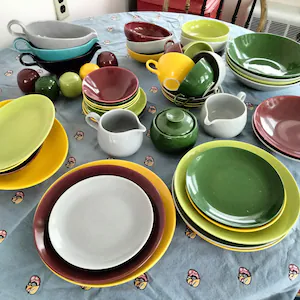
We introduced Rhythm in three distinct mid-century glazes that remain the most sought-after today. Chartreuse—a warm yellow-green that epitomized 1950s optimism—stands as the most iconic Rhythm colorway. Gray offered a cooler, sophisticated alternative for modern interiors, while Ivory provided a neutral canvas that worked in any setting.
Each glaze was applied by hand before firing, creating subtle variations in tone and pooling along the raised rings that make every piece unique. The high-temperature firing locked the glaze into the china body, preventing the fading and wear common in decal-decorated dinnerware of the same era. Today, well-preserved Rhythm pieces retain their original luster, a testament to our glaze chemistry and firing protocols.
Piece availability and place settings
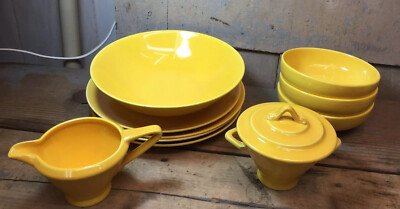
A standard Rhythm place setting includes a 10-inch dinner plate, 9-inch luncheon plate, 6-inch bread plate, cup, and saucer. We also produced coupe soup bowls, fruit bowls, and cereal bowls to complete the service. Serving pieces—platters in three sizes, covered vegetable bowls, gravy boats, and sugar-and-creamer sets—allowed hosts to present a fully coordinated table.
Mixing Rhythm with other Homer Laughlin lines
The raised-ring border on Rhythm coordinates beautifully with our plain Harlequin and Fiesta serving pieces from the same period. Many collectors build eclectic table settings by pairing Rhythm dinner plates with contrasting china patterns for salad or dessert courses, creating visual interest while maintaining mid-century cohesion. The neutral Ivory glaze in particular serves as a foundational layer that supports bolder accent colors.
Care and durability
We engineered Rhythm for everyday use, not display-only china. The vitrified body withstands thermal shock, making it safe for microwave reheating and dishwasher cleaning. Load pieces with adequate spacing to prevent contact chipping, and avoid abrasive scouring pads that can dull the glaze over time.
Crazing—the fine network of cracks that plagues many vintage china patterns—rarely affects well-maintained Rhythm pieces. Our firing temperatures vitrified the clay and glaze into a single stable matrix that resists moisture absorption. If you inherit a set with existing crazing, it’s purely cosmetic and won’t compromise strength or food safety. A gentle soak in warm water and dish soap removes decades of accumulated grime without harsh chemicals.
More streamlined dinnerware from Homer Laughlin




Rated 4.8 by verified buyers
Questions about Rhythm dinnerware
No, we discontinued Rhythm in the early 1960s after more than a decade of production. All Rhythm pieces available today are vintage originals from that era. We occasionally see interest in reissuing classic patterns, but currently Rhythm remains a collector’s pattern available only through secondary markets and estate sales.
Authentic pieces carry our Homer Laughlin backstamp and date codes from the 1950s manufacturing period. The pattern’s enduring popularity speaks to the timeless appeal of mid-century American design.
While both feature concentric rings, Rhythm presents raised relief bands molded into the china body, creating a tactile texture you can feel with your fingertips. Fiesta’s rings are painted or glazed onto a smooth surface. Rhythm also used pastel and neutral glazes like Chartreuse, Gray, and Ivory, whereas Fiesta launched with bolder primary colors.
The shapes differ too—Rhythm adopted more streamlined, minimal profiles suited to 1950s modernism, while Fiesta retained its Art Deco curves from the 1930s original design. Both lines demonstrate our commitment to distinctive, durable American-made dinnerware.
Yes, our Rhythm pattern was designed for regular dishwasher use. The high-fired vitrified body and glaze withstand modern automatic dishwashers without issue. We recommend using a gentle cycle and allowing adequate spacing between pieces to prevent contact chipping.
Avoid harsh abrasive detergents or scouring pads that might dull the glaze over time. If you notice stubborn stains from decades of use, a paste of baking soda and water applied gently will lift most discoloration without scratching the surface.
Chartreuse commands the highest collector interest due to its quintessential mid-century aesthetic and relative scarcity. We produced fewer Chartreuse pieces compared to Ivory, making complete place settings harder to assemble today. Gray ranks second in collectibility, prized for its sophisticated neutral tone.
Ivory, while beautiful and versatile, appears more frequently in estate sales and antique markets, typically at lower price points. Condition matters more than color for serious collectors—pristine Ivory pieces in original sets can exceed mixed-condition Chartreuse fragments in value.
Check the underside for our stamped backstamp reading “Rhythm” alongside “Homer Laughlin” or the “HLC” monogram. Date codes typically appear as a letter-number combination indicating month and year of manufacture. The raised concentric rings should show crisp, uniform definition—hand-pressed originals have sharper relief than later reproductions.
Weight provides another authentication clue. Genuine Rhythm china feels substantial and dense, heavier than modern commercial dinnerware. Tap a piece gently with your fingernail; authentic high-fired china produces a clear bell tone, while reproductions sound dull or muffled.
Absolutely. Rhythm coordinates beautifully with our Harlequin and Fiesta lines from the same mid-century period. The raised rings echo Fiesta’s concentric band motif, creating visual harmony when you layer patterns. Many collectors use Rhythm dinner plates as a neutral foundation and add Fiesta or Harlequin accent pieces in contrasting colors for salad or dessert courses.
The Ivory glaze in particular serves as an ideal backdrop for bolder vintage colors. Experiment with mixing eras too—Rhythm’s clean lines pair surprisingly well with our earlier art-deco patterns and even contemporary Fiesta reissues.
We produced Rhythm dinner plates in a standard 10-inch diameter, luncheon plates at 9 inches, and bread-and-butter plates at 6 inches. These three sizes formed the core of a complete place setting. We also offered 7-inch salad plates in limited production runs, though these appear less frequently in surviving sets.
Serving platters came in small (11 inches), medium (13 inches), and large (15 inches) ovals. The graduated sizing allowed hosts to coordinate presentation across appetizers, entrees, and large-format roasts or holiday turkeys.